
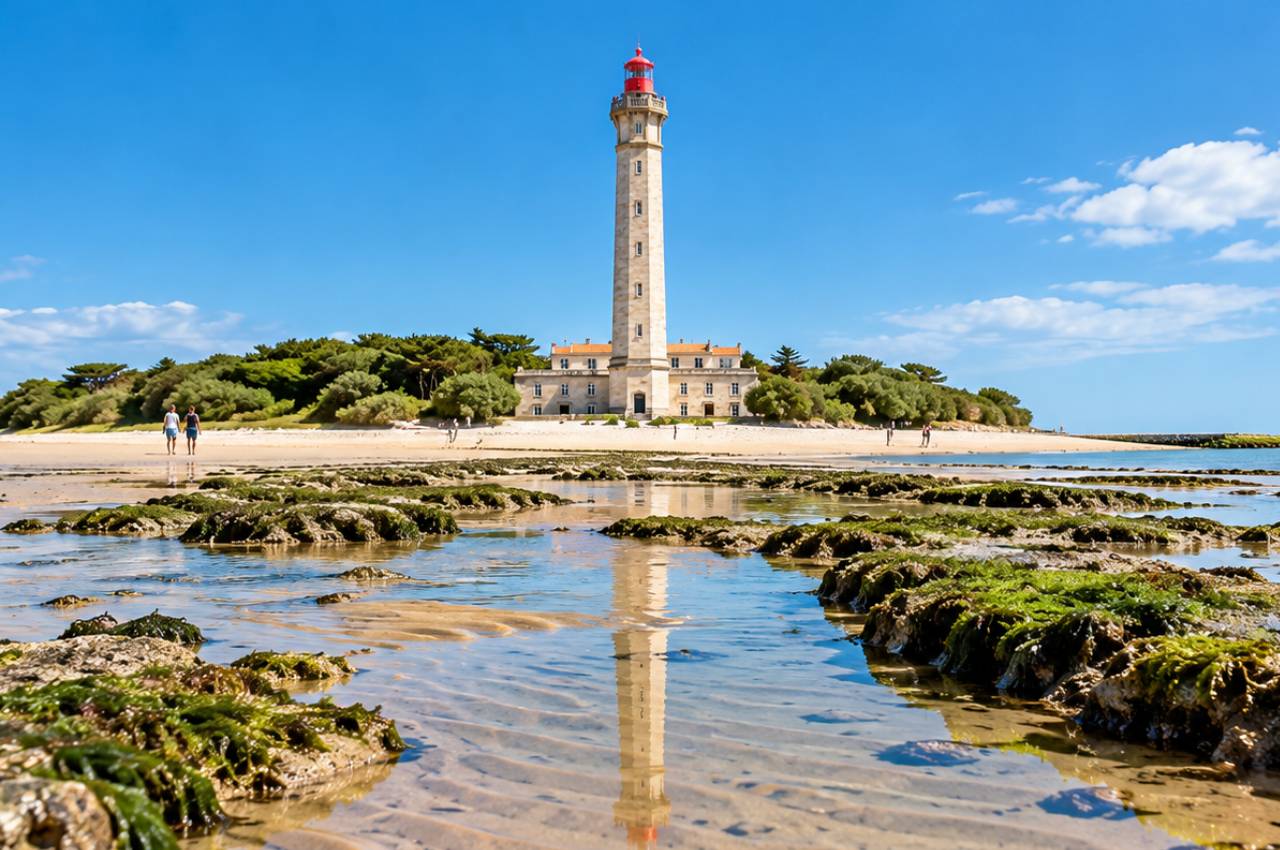
On Île de Ré, the sea recedes and returns twice a day, and this rhythm dictates nearly all coastal activities. Knowing the tide schedule on Île de Ré allows you to choose the right time for a swim, a walk along the foreshore, or a session of shore fishing. Tidal coefficients, schedules, water levels: each piece of information is useful. Here’s how to read the forecasts, understand the moon’s role, and safely enjoy the beaches of Île de Ré to the fullest during your stay at our campsite on the island.
Key points to remember
| Element | Key Points |
|---|---|
| Tidal Cycle | Semi-diurnal tides: 2 high tides and 2 low tides per day. |
| Tidal Coefficient | Range from 20 to 120; above 100, spring tides occur. |
| Best Time to Fish | Tide coefficient greater than 80, about 1.5 to 2 hours before low tide. |
| Where to find the schedules | Official forecasts from SHOM and signs at tourist offices. |
| Beach Fishing Quota | Maximum of 5 kg per person per day; minimum size limits apply. |
Understanding the Tides on Île de Ré
The tides on Île de Ré follow a semidiurnal cycle, typical of the Atlantic coast: the sea rises and falls twice a day, with about 6 hours between each low tide and each high tide.
The amplitude—that is, the difference in water level between the two—varies greatly from one day to the next. We thus distinguish between periods of high tide, when the sea recedes significantly from the foreshore, and periods of low tide, when the tides are less pronounced.
During the spring tides, the beaches in the north of the island reveal vast stretches of sand and rocks, perfect for walking or observing wildlife.
This steady rhythm explains why locals check the tide before every trip: the same beach looks completely different depending on the time of day.
Tide Coefficients and Timetables for Île de Ré
The tidal coefficient measures the magnitude of the phenomenon on a scale from 20 to 120. A coefficient of 45 corresponds to a neap tide, around 95 to a spring tide, and above 100 to a spring tide.
This figure depends on the positions of the moon and the sun. When the new moon or the full moon aligns the two celestial bodies, their gravitational forces combine, and the tides become stronger.
Conversely, during the first and last quarters, the coefficients decrease. The most dramatic changes occur around the equinoxes, around March 21 and September 23, when the coefficient can exceed 115.
For specific times, refer to the official SHOM forecasts, which are included in calendars and apps. Tourist offices also display these tide times, along with sunrise and sunset times.
In a nutshell
- The tidal coefficient scale ranges from 20 to 120.
- Equinox spring tides sometimes exceed a coefficient of 115.
- There are two high tides and two low tides every day.
- Beach fishing becomes favorable when the tidal coefficient exceeds 80.
Today’s tide at the reference port of Saint-Martin-de-Ré: high and low tide times, water level, and tidal coefficient, updated automatically (Marée-Live data, based on the SHOM hydrographic zero).
Shellfishing at Low Tide: Hotspots and Best Practices
Shellfish gathering remains the main attraction at low tide on the Île de Ré. It takes place on the exposed foreshore, where visitors search for clams, cockles, razor clams, velvet crabs, or gray shrimp. For a successful outing, aim for a tidal coefficient above 80 and head down to the beach about 1½ to 2 hours before low tide. Regulations strictly govern this recreational fishing activity:
- The limit is 5 kg per person per day, for all species combined.
- The minimum sizes are 4 cm for clams, 3 cm for cockles, and 10 cm for razor clams.
- Fishing remains prohibited in ports, within 100 meters of them, and around oyster farms.
- The Lilleau des Niges Nature Reserve, in the Fier d’Ars, is fully protected.
- Every angler must fill in the holes, put the rocks back in place, and protect the seaweed.
Finally, always keep an eye on the time the tide comes in: during spring tides, the tide comes in quickly and can catch walkers by surprise.
On our beaches, we always advise our vacationers to head out a good hour before low tide and to keep an eye on the rising tide.
Plan Your Stay Around the Tides from La Couarde-sur-Mer
From La Couarde-sur-Mer, following the tide to Île de Ré has become a vacation tradition. Our campsite, La Tour des Prises, is located 600 meters from Les Prises Beach, one of the island’s most beautiful beaches. At low tide, you can walk out onto a wide tidal flat; at high tide, it’s time for a swim. Our rental bikes will take you to the bike paths in just a few minutes, where you can ride to the ports of La Flotte, Saint-Martin-de-Ré, or Ars-en-Ré. Staying at our campsite means setting your days to the rhythm of the tides: beachcombing in the morning, swimming in the afternoon, and watching the sunset over the salt marshes. You’ll discoverthe Île de Ré as you travel along the water, passing beaches, vineyards, and historic villages.
Download a tide app before you arrive and note the two tidal coefficients for the day. On the morning of a spring tide, the foreshore at Les Prises Beach turns into a playground for children. Be sure to wear appropriate footwear: the rocks exposed at low tide are often slippery.
Do you dream of spending your days in tune with the tides, between beachcombing and sunsets over the foreshore? Book your stay at La Tour des Prises campsite and settle in just a stone’s throw from Les Prises Beach, in the heart of Île de Ré.