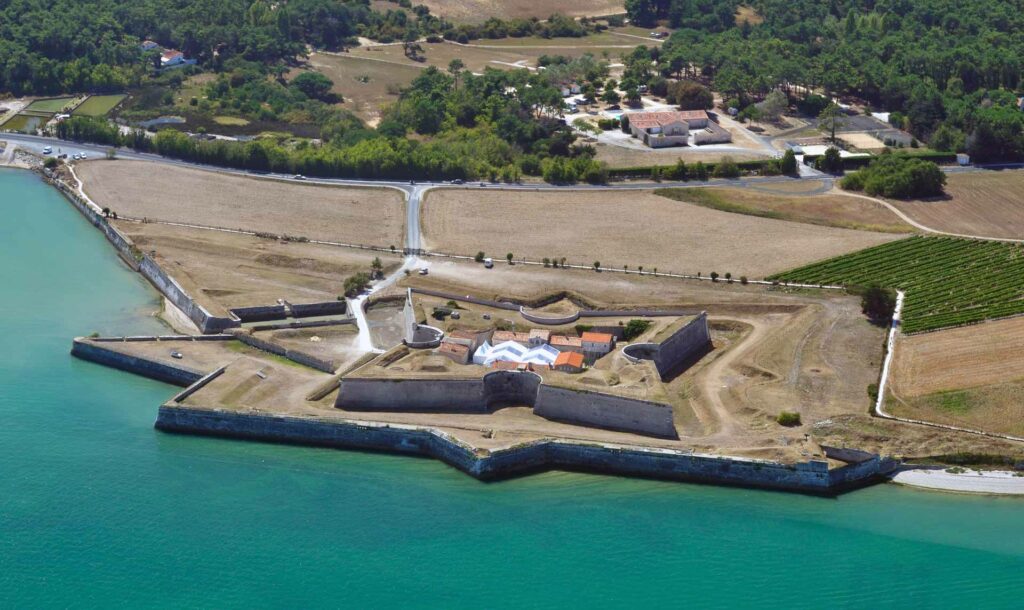
Fort de la Prée is located on the Île de Ré near a small port that has served as a crossing point to La Rochelle since the Middle Ages. From here, the crossing is only 5 kilometers. Fort de la Prée is the oldest of the island’s Vauban fortifications. A gem of military heritage not to be missed during your stay at La Tour des Prises campsite.
History of Fort de la Prée
It was decided to build the fort at La Prée before fortifying St Martin de Ré, to avoid invasion of the island by the English, who were ready to support the Protestant rebels. At the same time, the island’s main access point was secured, giving the crown a firm grip on the island and providing it with an important means of access.
In order to control the Protestant population of the Ile de Ré in the early 17th century, to ensure that they would not collaborate with the English enemy, and at the same time to protect the island from that same enemy, it had to be fortified.
The island of Ré was strategic, as it could be used by the enemy as a base from which to attack La Rochelle and, to a lesser extent, Rochefort.
The first plans date back to 1625. They show a small star-shaped fort surrounded by a moat on the landward side, bordered by a renovated outer envelope with a ditch opposite. This ditch is preceded by a covered path. The fort had a small harbor, covered by the outer shell.
The fort had the opportunity to prove its worth as early as 1627, when the English laid siege to Saint-Martin-de-Ré, which was not yet fully fortified. Fort de la Prée served as a safe harbor from which the French launched their counterattack. The English were forced to abandon their siege and retreat.
In the years that followed, the fort’s seaward front was reinforced and the covered passageway on the landward side was doubled in width, making the fort much larger. In 1684, Vauban ordered the destruction of the covered passages and the fort’s outer wall.
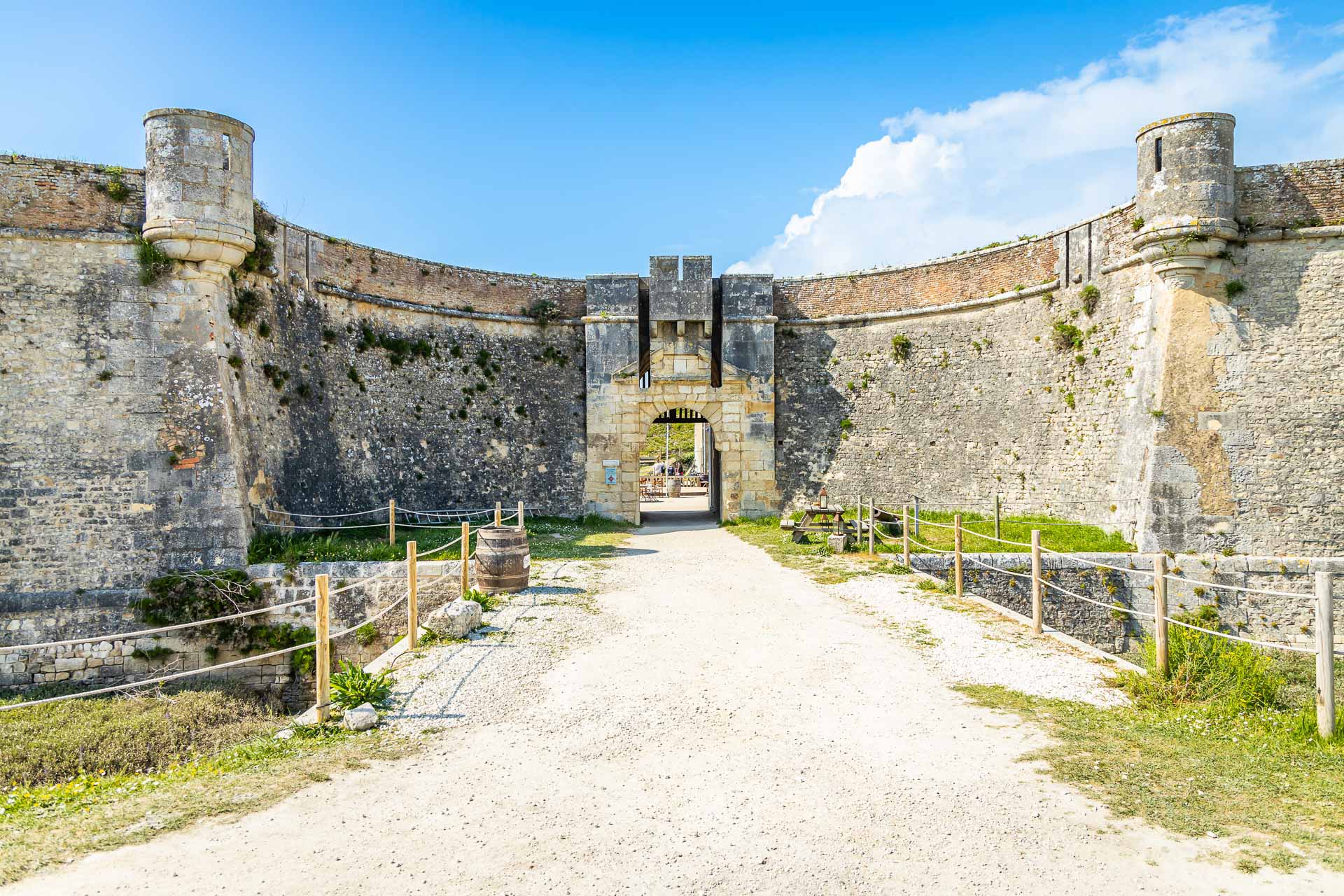
The fort seen from the landward side
The defenses around the harbor were reinforced, barracks were built along the right waterfront (the foundations of which are still visible today), and a new covered walkway was constructed. These changes gave the fort the appearance it has more or less retained to this day.
One interesting aspect of Fort de la Prée is how it was viewed by the engineers who worked there. Most of them complained about its size, claiming it was too small, rather than the fact that the semicircular curtain walls did not adequately flank the bastions or that there was not enough drinking water. Yet they all wanted to preserve the fort and actually reduced its size themselves.
Looking at the original plans, one can see that the star-shaped fort functions more like a keep (central tower), with the outer enclosure and the covered walkway forming the first layers of defense. Viewed this way, the fort’s shape makes more sense.
In the 1930s, the fort lost its military significance, and over the centuries, it has not changed much. Air-raid shelters were added, and some of the buildings inside the fort were modified during the 19th century. Later, during World War II, the Nazis built a bunker inside the fort.
Visit Fort de la Prée
The guns in the batteries at sea level were able to damage ships very effectively by striking their hulls at the waterline.
Although it may not be the most logical way to construct a curtain wall, the semicircular shapes are a very distinctive feature of the fort—one that will always make it memorable. It’s a truly beautiful feature of this fort.
Apart from that, the fort’s compact layout makes it easy to take in its entire defensive system—the seaward side, the landward side, and the harbor. These features make Fort de la Prée a wonderful fort to visit, and it’s easy to combine a visit there with a trip to the Île de Ré. The fort is just 18 km from the La Tour des Prises campsite.